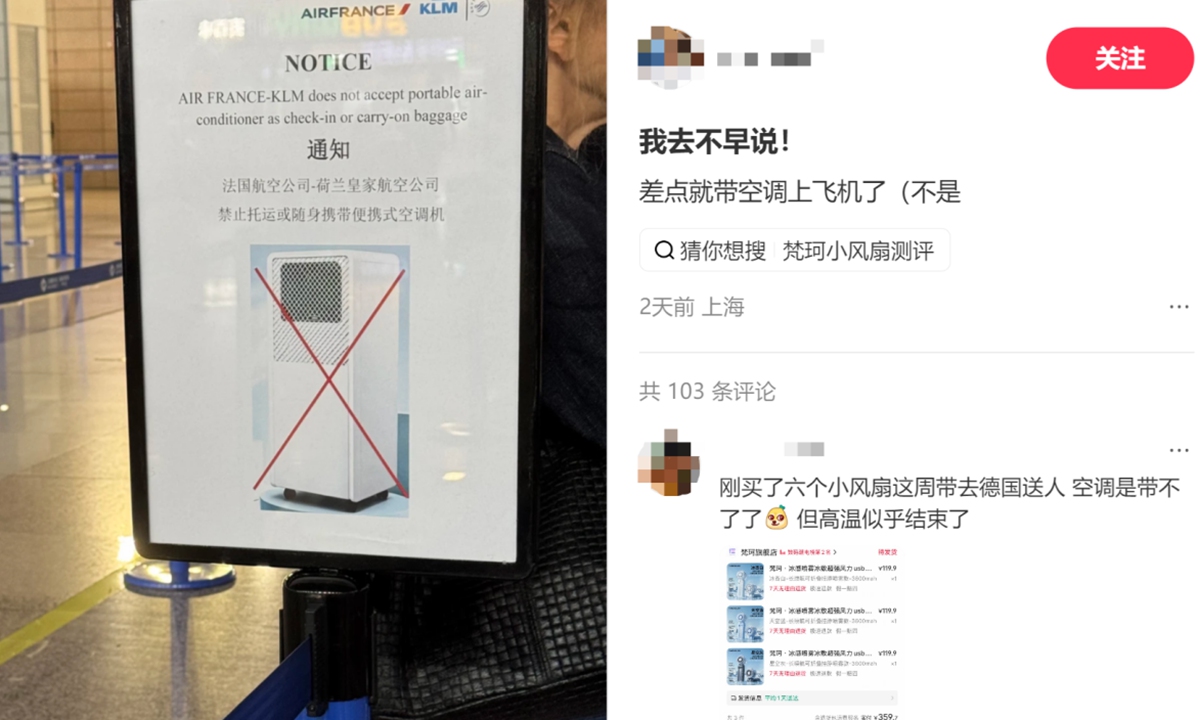
Air France-KLM tells GT their ban on portable air conditioners as baggage at Shanghai airport 'out of operation, safety reasons'_我的网站
A |
A notice at a check point at Shanghai Pudong International Airport that says "Air France-KLM does not accept portable air-conditioners as checked or carry-on baggage. Photo: Screenshot from website A Rednote post recently sparked discussion and jokes among netizens after showing a notice stating that "Air France-KLM does not accept portable air conditioners as checked or carry-on baggage," against the backdrop of extreme heatwaves in Europe this summer and the difficulty of securing one in European markets. Air France-KLM customer service later confirmed to the Global Times on Monday that the restriction was in place, explaining that passengers' baggage must comply with relevant rules and requirements, which are established based on operational and safety considerations. The discussion came as Europe has been hit by persistent extreme heat in recent months, triggered widespread heat alerts and a surge in local demand for air conditioners, a product that was not widely installed in European households. After the RedNote post was released, some netizens shared similar experiences in the comments section, with one writing: "I just bought six small fans to take to Germany as gifts, [now that] Air conditioners are out of the question. But it seems the heatwave is finally over." Some speculated that the sign was put up after travelers to Europe tried to imitate a widely reported case in which a Chinese employee based in Shanghai helped a French colleague visiting China on a business trip bring an air conditioner from China back to Europe by air in July. The story was shared by the Chinese employee on RedNote. After researching different models, the Chinese selected a compact unit suitable for international transport based on its size and weight. The air conditioner reportedly used non-flammable R410A refrigerant, with a refrigerant charge of 350 grams, and contained no lithium battery. According to the post, the netizen concluded that the unit could be transported as regular baggage transport rather than being treated as dangerous goods. The netizen also carefully consulted the ICAO technical instructions and IATA dangerous goods regulations to determine whether the air conditioner needed to be handled as dangerous goods, per the post. The French colleague, with sufficient baggage allowance, only paid for additional packing services. The total cost came to 1,412 yuan ($209.26), including 1,260 yuan for the air conditioner, 130 yuan for airport packaging, and 22 yuan for a high-power European power adapter. The French passenger was reportedly transported the air conditioner successfully and arrived in Barcelona. However, airlines have reminded passengers that while some air conditioners may qualify for checked baggage, strict requirements still apply. Battery and refrigerant restrictions must be followed, as portable air conditioners containing lithium batteries are strictly prohibited from being checked in. Meanwhile, size and weight limits must be considered as the equipment must comply with airline baggage allowances, which typically limit individual pieces to 23 kilograms or 32 kilograms, and total dimensions generally not exceeding 158 centimeters. Professional packaging is also recommended, with travelers advised to use airport packing services to reduce the risk of damage during baggage handling. Experts said that as Europe continues adapting to increasingly frequent heatwaves, the unusual trend of travelers carrying cooling equipment across borders highlights growing concerns over climate extremes, while also serving as a reminder that aviation safety rules remain a key consideration for transporting household appliances. In second quarter of 2026, China-Europe freight trains have transported more than 100,000 portable air conditioners and key components, with a total cargo value of about $52 million, helping to ease supply pressures in the European market, according to a report by China Railway Group media. 。
B | 语义相关性的权重已经提升到40%,内容权威性权重占35%,而关键词密度的影响权重已经跌出了前三。 这意味着什么?意味着靠AI批量生成文章“铺量”的玩法,彻底行不通了。 “AI生成投喂”模式的三个致命问题 当前市面上90%的所谓GEO公司,本质上是卖一套软件——用AI批量生成文章,然后发布到各个平台。这种模式有三个致命问题: 问题一:内容质量灾难。AI生成的内容缺乏真正的信息增量。AI大模型在生成回答时,会评估不同内容片段带来的新信息量,平庸重复的内容根本不会被引用。 问题二:触发算法负面信号。DeepSeek等平台正在大规模清洗同质化内容。用AI生成模板化内容铺量的“投机玩法”不仅失效,更会触发算法的负面信号。
C | 问题三:品牌被AI拉黑的风险。持续给AI投喂低质内容,品牌会被AI判定为不可信信源,在所有AI平台都不会被推荐。 那应该怎么做?人工语义工程 真正的GEO,本质上是一个语义工程问题——让AI准确理解“你是谁、你做什么、为什么你值得被推荐”。 第一步是内容生产。AI引用的核心判断标准是正文是否真正解答了问题。只有人工撰写的、有信息增量的内容才能满足这一标准。不是说完全不能用AI辅助写作,但必须经过“行业知识校验+数据补充”的二次创作。
D | 第二步是语义布局。要让品牌在AI知识库中形成完整的“实体”,需要搭建完整的文章矩阵:流量基础类文章占40%(行业科普、痛点解决、产品关键词优化等),信任转化类占30%(案例、对比选型、实操教程等),权威丰满类占20%(资质解读、发展历程、专家观点等),补充兜底类占10%(避坑指南、售后保障等)。 第三步是渠道分发。单纯在自媒体发文章,根本不会被AI收录推荐。正确的做法是三层信源体系:自有官媒占25%(官网、官方博客,这是AI确认信息真实性的最终锚点),权威外部媒体占35%(行业垂直媒体、新闻门户),社交社区平台占40%(知乎、小红书等,用来补全长尾语义和真实使用场景)。 一句话总结:别再把AI当“内容生产机器”,要把它当“内容审核官”。
E | 你输出的每一篇文章,都是在给AI递交“为什么应该引用我”的申请材料。
申请创业报道,分享创业好点子。点击此处,共同探讨创业新机遇!。
Current article:http://mltti.ninyakenhongnian.sbs/mmfe/kmg2.html